
Clear Estimates Research · cost data for remodeling contractors
The limits of cost per square foot: what it really costs to build a house in every U.S. ZIP code
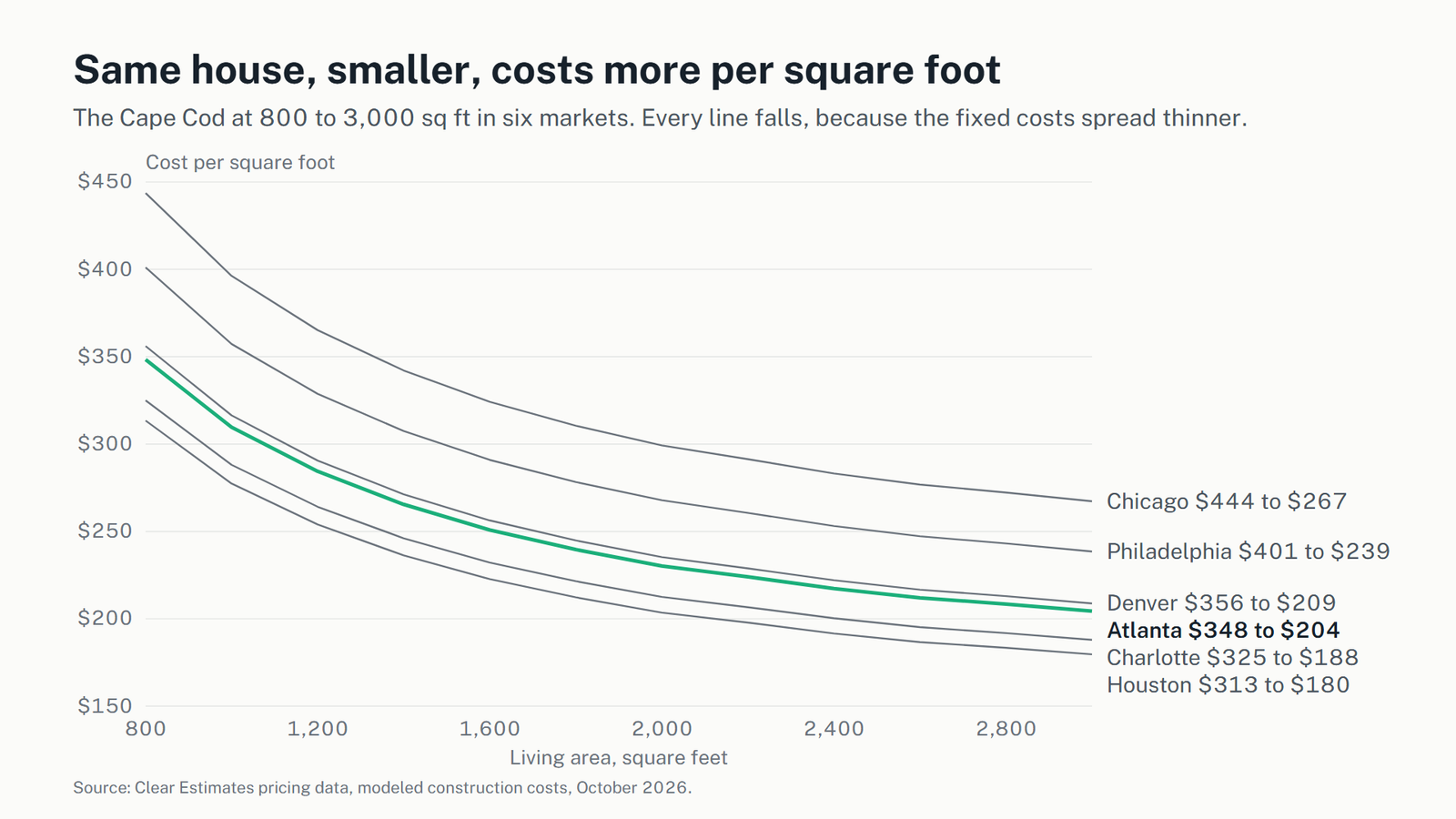
A price per square foot leaves out what you build, where you build it, and how big it is. The same Cape Cod costs nearly twice as much in one ZIP code as in another, and $348 a square foot at 800 square feet but $204 at 3,000.
By Nolan Orfield, PhD, Founder ·
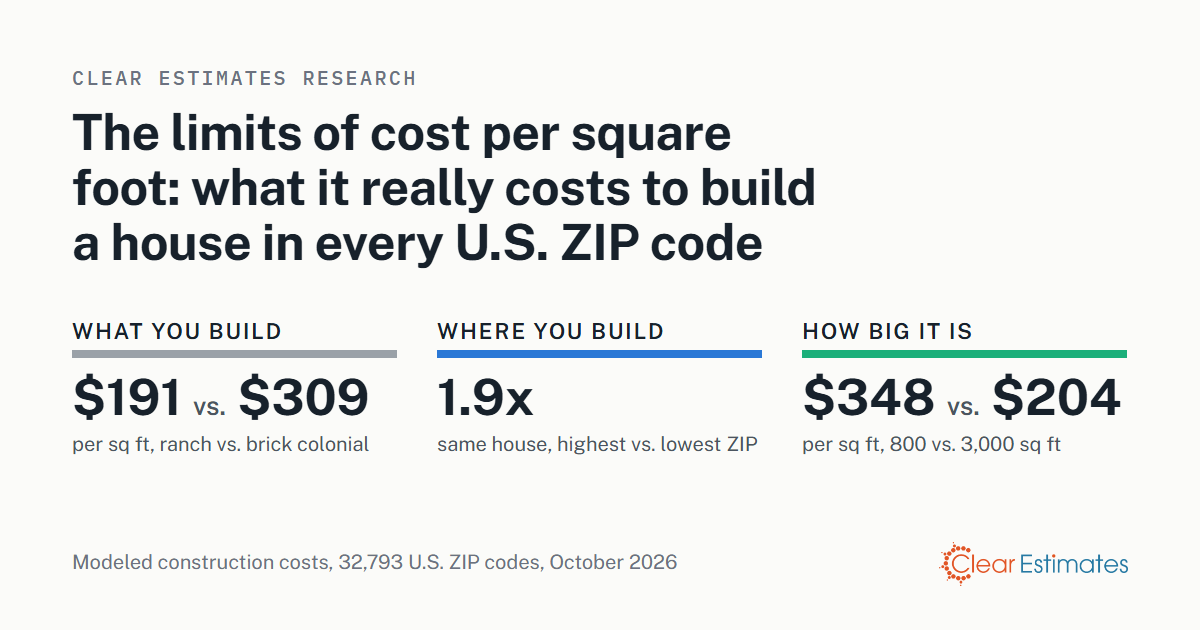
Per sq ft, ranch vs. brick colonial
$191 vs. $309
Same house, highest ZIP vs. lowest
1.9x
Per sq ft, same house across Illinois
$237 to $309
Per sq ft, same house at 800 vs. 3,000
$348 vs. $204
Ask what a new house costs per square foot and you usually get one number. It's a handy rule of thumb, but it hides three things: what kind of house it is, where it's built, and how big it is. We priced three homes, complete, in all 32,793 ZIP codes in the 50 states and D.C., then priced one of them at 12 sizes, to see how far each of those moves the number.
What we measured
Each home is priced from site preparation to the roof, with that ZIP code's material costs, labor rates and the markup contractors there typically charge. Land is not included. These are modeled construction costs, not sale prices or appraisals.
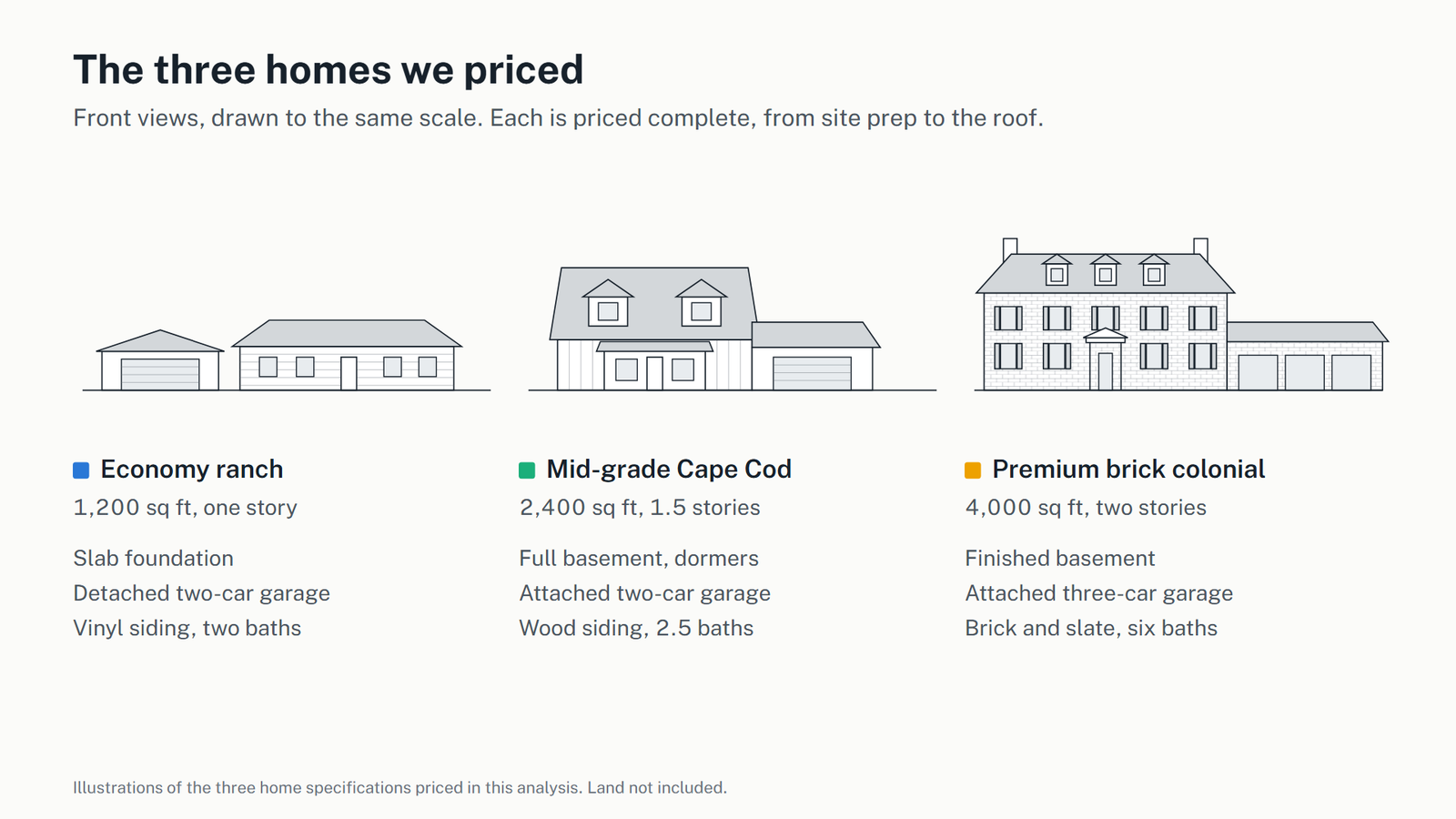
- Economy ranch: 1,200 square feet on one story, slab foundation, detached two-car garage, vinyl siding, an economy kitchen and two full baths.
- Mid-grade Cape Cod: 2,400 square feet on 1.5 stories over a full basement, attached two-car garage, wood siding, dormers, an average kitchen, two and a half baths and a cedar deck.
- Premium brick colonial: 4,000 square feet on two stories, plus a 1,500-square-foot finished basement, attached three-car garage, brick and slate, a designer kitchen, four full and two half baths, and two fireplaces.
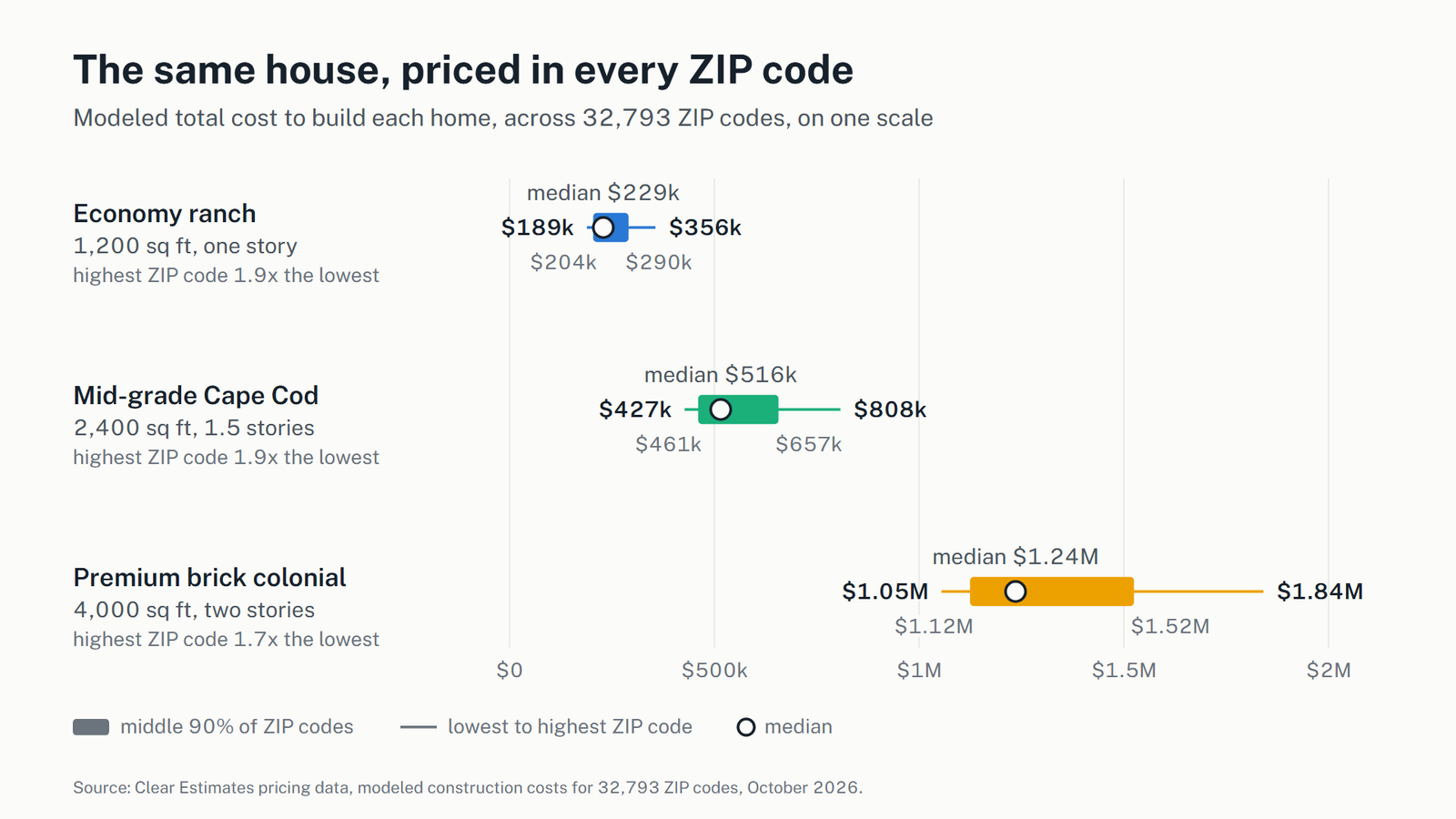
The same house, up to 1.9 times the price
The mid-grade Cape Cod costs about $516,000 to build in the median ZIP code. In nine of every ten ZIP codes it costs between $461,000 and $657,000. At the extremes, it runs from $427,000 in the Rio Grande Valley of Texas to $808,000 in the western suburbs of Chicago.
The other two homes spread the same way. The economy ranch runs from $189,000 to $356,000, and the brick colonial from $1.05 million to $1.84 million.
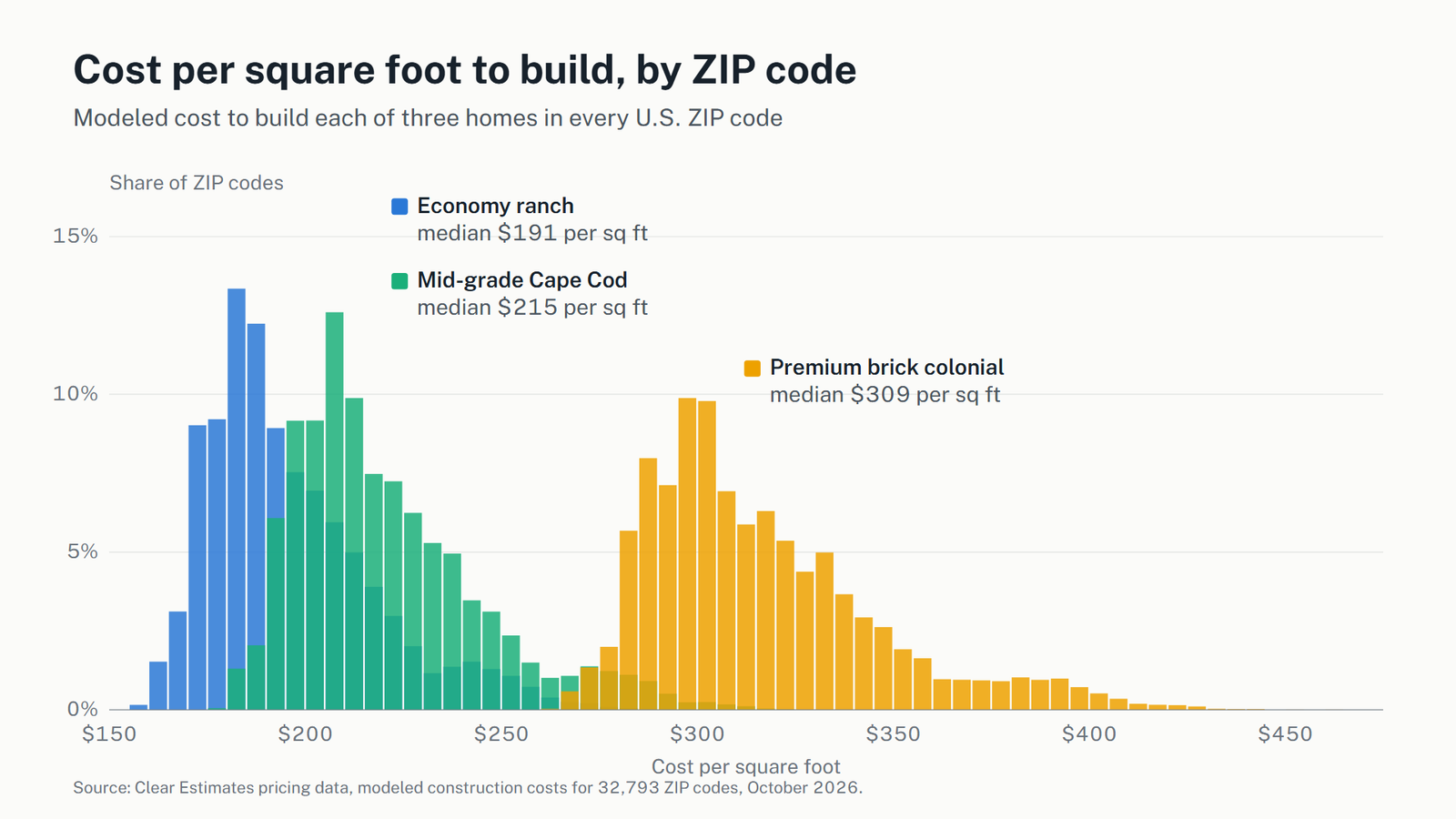
Cost per square foot depends on the house
At the median ZIP code, the economy ranch costs $191 per square foot, the Cape Cod $215 and the brick colonial $309.
The ranch has half the Cape Cod's space and cheaper finishes, but it costs only 11% less per square foot. A small house still needs a foundation, a roof, a kitchen, baths, heating and cooling, and site work, and it spreads them over fewer square feet. At the other end, brick, slate and designer finishes put the colonial 44% above the Cape Cod per square foot.
A price per square foot isn't a fixed rate
Even for one house, cost per square foot changes with size. We priced the same Cape Cod at 12 sizes, from 800 to 3,000 square feet, and kept everything else the same: the basement, the two-car garage, the kitchen, two and a half baths, the fireplace, the deck and the driveway. We did it in six markets, from Houston to Chicago.
Total cost rises in a nearly perfect straight line, but the line doesn't start at zero. In Atlanta, the market closest to the national median, the Cape Cod costs about $158,000 before its first square foot, then about $152 for each square foot after that. The $158,000 is the part of the house that doesn't grow with it, like the garage, kitchen, baths, chimney, deck and driveway, plus walls and roof, which grow more slowly than the floor area.
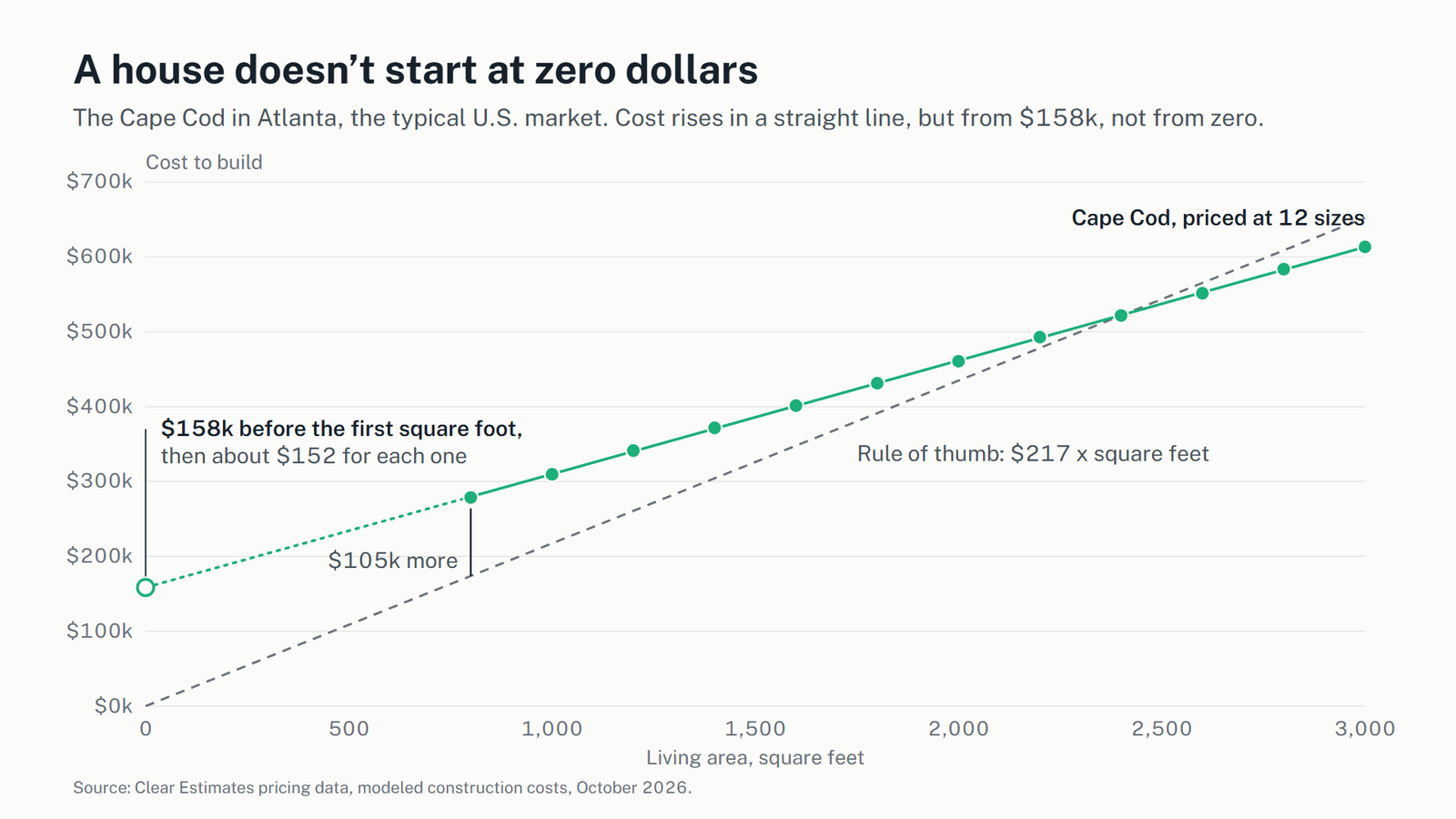
So cost per square foot falls as the same house gets bigger. In Atlanta the Cape Cod runs $348 per square foot at 800 square feet, $217 at 2,400 and $204 at 3,000. Priced at $217 per square foot, the 800-square-foot version would come in $105,000 short. All six markets show the same curve. The fixed part runs from about $147,000 in Houston to $194,000 in Chicago, about 30% of the cost of the 2,400-square-foot home.
A better rule of thumb has two numbers: a fixed amount for the house, plus a rate for each square foot. Both depend on the house and the market.
Where it costs more to build
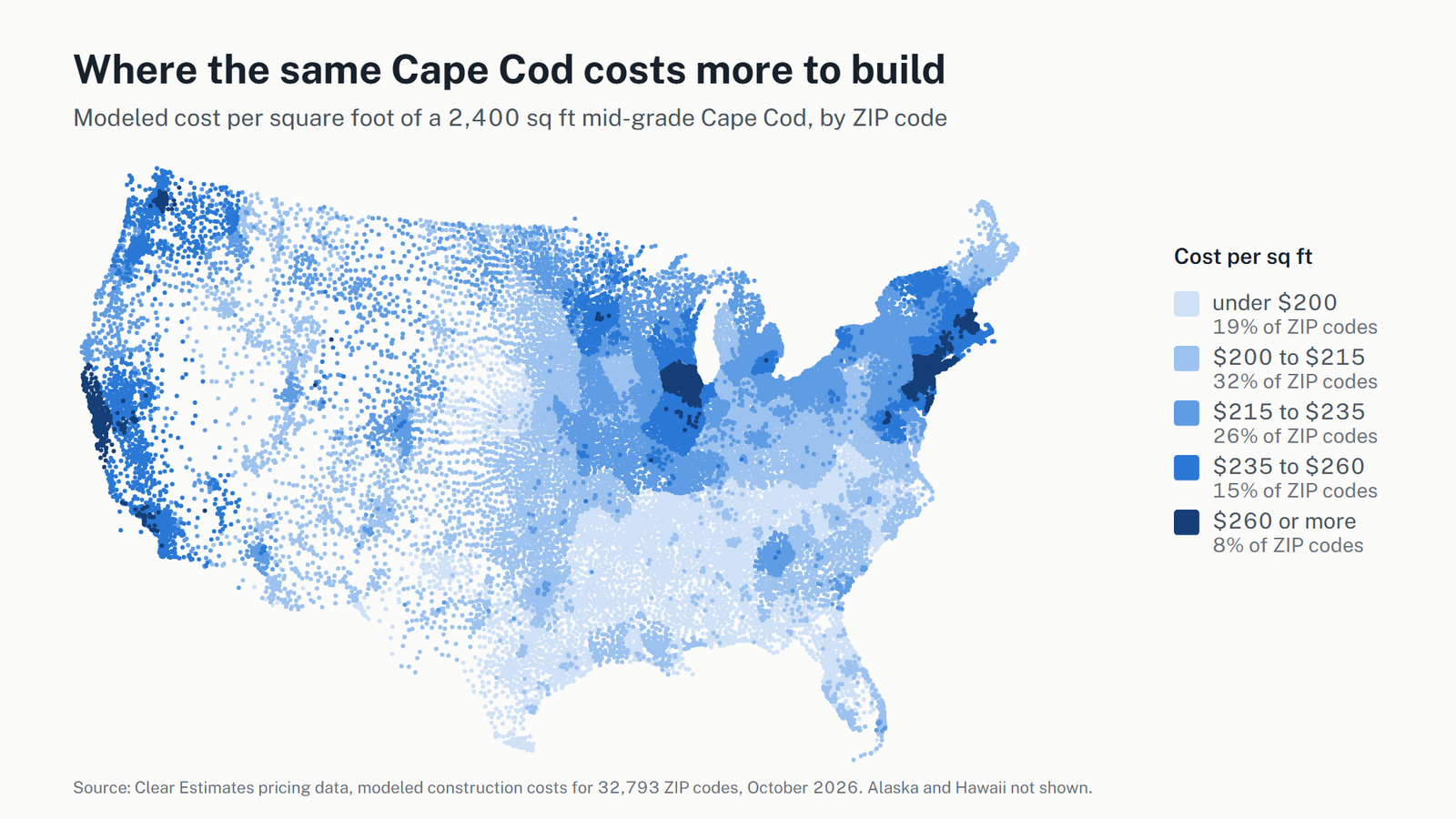
The Cape Cod costs $260 or more per square foot in 8% of ZIP codes, mostly around Chicago, New York and northern New Jersey, the San Francisco Bay Area and Boston, and in Alaska and Hawaii. It costs under $200 in 19% of ZIP codes, most of them in Texas, Tennessee, Florida, Arkansas and Alabama. The least expensive markets, around McAllen, El Paso, Birmingham and Little Rock, come in near $181 to $190 per square foot. The most expensive, around San Francisco, Honolulu and Chicago, are near $290 to $310.
A state average isn't close enough
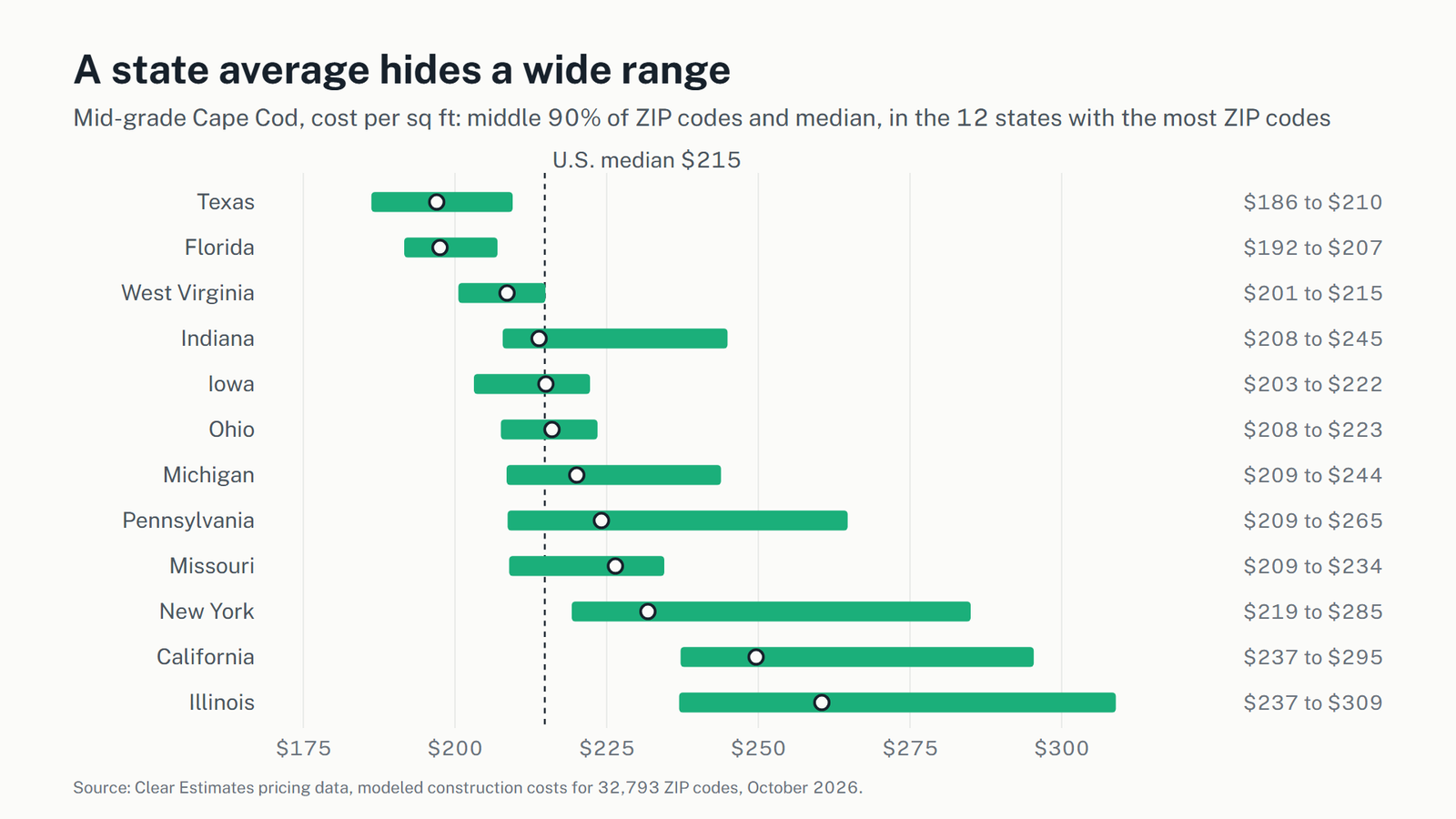
Costs also spread out inside a state. For the Cape Cod, the middle nine in ten ZIP codes in Illinois run from $237 to $309 per square foot, in California from $237 to $295, and in New York from $219 to $285. Texas and Florida are much tighter, at $186 to $210 and $192 to $207.
Against a single national figure, the Cape Cod costs more than 10% above the median in about one in five ZIP codes, and more than 10% below it in about one in fifteen.
What it means for your estimates
A per-square-foot number is a fine first check. As an estimate, it can easily be off by a third, because it carries the house, the size and the market it came from.
- Match the number to the house. An economy ranch and a brick colonial differ by more than $100 per square foot in the same ZIP code.
- Adjust for size. The same house costs more per square foot when it's smaller: $217 per square foot from a 2,400-square-foot Cape Cod underprices an 800-square-foot one by more than a third.
- Use local labor rates and material costs, not a state or national average. The Cape Cod costs 21% more per square foot in Chicago than in Milwaukee, 85 miles away.
- On insurance rebuilds after a fire or storm, a per-square-foot replacement figure may come from a different kind of house or a different market. A line-item estimate shows where the difference is.
Clear Estimates tracks material prices and labor rates for 349 markets and updates them every quarter. See what each home costs in your market.